
Highway defects go far beyond simple wear and tear. Our roadways suffer numerous hazards, including:
- Missing or obscured roadway signs
- Faulty traffic control devices
- Broken or improperly installed guardrails
- Construction zone hazards
- Pavement edge drop-offs
- Poorly designed or inadequately maintained road surfaces
Dangerous Road Conditions Cause Serious Highway Accidents
These defects often lead to catastrophic events, including rollovers, head‑on collisions, crashes into construction equipment, and truck jackknifing accidents.
Our Experienced Attorneys Can Help You
Injuries from these crashes range from minor to life‑altering, including:
- Traumatic brain injuries
- Facial injuries and lacerations
- Back, neck, and spinal cord injuries
- Chest and abdominal trauma
- Leg, knee, and pelvic injuries
Spinal injuries, in particular, often result from impacts that fracture, crush, or dislocate vertebrae.
Case Results
$1.5 Million Settlement when a client suffered severe permanent lung injuries after losing control of his vehicle upon encountering a four-inch pavement edge drop-off.
Who Is Responsible for Keeping Our Highways Safe?
Government agencies maintain public roads, but liability for a dangerous roadway accident often extends beyond the state or local entity. Our attorneys investigate every angle to determine who failed in their duty to keep the road safe. Responsible parties may include:
- Government entities responsible for road design, maintenance, or repairs
- Contractors or construction companies performing roadwork
- Manufacturers of defective guardrails, signs, or traffic control devices (that may have contributed to the accident)
- Other third parties
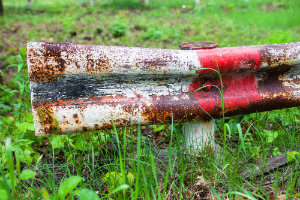
Damaged, rusted guard rail
Highway defect cases often involve multiple parties. You need a legal team experienced in negotiating with local or state government entities and their contractors, who will advocate on your behalf and who will hold all responsible parties accountable.
Case Results
$2.5 Million Wrongful Death Arbitration Award against the Missouri Highway and Transportation Commission for inadequate signing in a construction zone.
Have questions? Contact our staff at (877) 284-6600.
Why You Need an Experienced Highway Defect Attorney
In cases involving highway defects, you want a personal injury lawyer in Kansas City who understands the relevant statutes to evaluate your case.
Highway defect cases require extensive investigation, expert analysis, and a deep understanding of state and federal roadway standards. When we evaluate your case—free of charge—we examine factors such as:
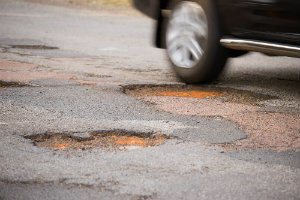
Potholes and other highway defects create dangerous roads.
- Defects or inadequacies in paving, including pavement defects, edge drop‑offs, and surface failures
- Guardrail placement and condition
- Adequacy of signs, warnings, and traffic control devices (alerting drivers to unusual driving conditions)
- Construction zone safety compliance
- Whether government or contractor negligence contributed to the crash
Our team is prepared to take your case through mediation, arbitration, or trial—whatever it takes to secure maximum compensation.
Need Additional Information?
- Find blog articles related to Automobile Accidents, Construction Work and Highway Defects
- Construction Work Zones
- Manual on Uniform Traffic Control Devices for Streets and Highways
- Federal Highway Administration
Legal Expertise. Proven Results. Trusted Advocacy.
Our lawyers have earned a reputation for successfully helping clients obtain sizeable settlements and verdicts against government authorities and construction companies. For you, this means experienced personal injury attorneys who are creative, resourceful, and tenacious in providing liability and protecting your legal rights.
You benefit from:
- Over 80 years of combined experience
- Trusted legal advisor committed to your needs
- Super Lawyers recognition for more than a decade
- The AV Preeminence Rating for Ethical Standards & Legal Ability
- Compassionate, client‑focused representation
Get a Free Case Evaluation from Experienced Highway Defect Attorneys
If you believe your automobile or truck accident was caused by unsafe road conditions, don’t wait. Evidence disappears quickly, and deadlines apply—especially when government entities are involved.
Contact us today for a free, no‑obligation case review. Our team is ready to fight for the compensation you deserve.
📞 Call (877) 284‑6600 📩 Request your free evaluation online
Call Today and Start Your Free Case Evaluation
Published: October 15, 2010 • Updated: April 25, 2026
Photo Credits:
- rootstocks(Natalia Kononchuk) – Image File – via depositphotos.com
- douwdejager(Douw de Jager) – Image File – via depositphotos.com
- Noppharat_th(Noppharat Manakul) – Image File -via depositphotos.com
FAQ
The Manual on Uniform Traffic Control Devices (MUTCD) establishes the nationwide standards that road managers must follow when installing and maintaining traffic control devices on all public streets, highways, bikeways, and even private roads open to public travel.
Administered by the Federal Highway Administration (FHWA) since 1971, the MUTCD serves as the authoritative guide for all traffic control devices. It outlines uniform requirements for road markings, highway signs, traffic signals, and other devices that help ensure safe and consistent travel across the United States.
The Missouri Department of Transportation (MoDot) oversees road construction and maintenance throughout Missouri and is responsible for ensuring that the state’s roads and highways remain safe for public travel. The MoDot website provides helpful information on current construction zones, driver safety tips, and statewide traffic accident statistics.
The Federal Highway Administration (FHWA)—a division of the U.S. Department of Transportation—works with state and local governments to establish guidelines for the safe design, construction, and maintenance of roadways. The FHWA also monitors traffic accidents and conducts inspections of crash sites where roadway design, maintenance issues, or defects may have contributed to the incident.